

Day 2 of the PMI’s Leadership Institute Meeting started off with a plenary session on acquiring and retaining members. PMI’s Tom Bates was the presenter, and he reviewed the same presentation that was covered at LIM in Europe back in May, where PMI discussed membership attrition patterns. Here are some key points:
- The constituent breakdown for PMI is evenly broken down as members-only, PMP-only, and PMP+member. Members leave in droves after getting certified. The surveys tell us that PMs become members for recognition, and they renew for knowledge
- As PMI leaders, we need to move from a transactional member relationship to an experiential one
- In 1997 93% of PMPs were North American. Today, it’s 55%. “we need to speak with a global voice”
Then, PMI’s Cindy Anderson talked about the marketing campaigns and services recently launched to address these patterns. The crowd was generally skeptical. Most of the leaders seemed to agree with PMI’s changes, but were very unhappy with the notification process. PMI charged us to tweak the way we serve our members, yet most of the leaders here interpreted that as more work. Another consistent theme was that leaders were not getting the memos PMI sends about these changes. When asked who in the group knew of PMI’s Facebook page or twitter feed (@PMInstitute), only 12 of 400 people raised their hands. So somebody is either not communicating effectively or somebody is not listening. It was a very revealing tiff.
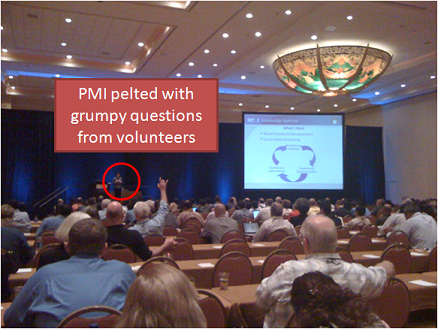
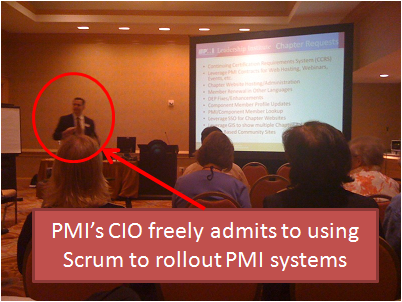
Next I attended a review of PMI’s technology systems, presented by their VP of technology, Frank Schettini. He explained that new PDU system is live, more scalable and easier for PMPs and vendors to use. He commited that PMI will be more transparent about the technology roadmap/backlog going forward, but set the expectation that improving the online user experience will be “incemental, not big-bang”. It was an interesting quote to me as an Agilist, but then he just came out and admitted, “yes, we use Scrum to roll out our technology”. How ’bout them apples?
After that was a breakout session on Virtual Communities. The big picture for PMI’s launching of communities of practice was described as becoming “the” preferred source for knowledge of the PM profession. That big picture means achieving credibility, relevance, and accessibility. Regarding “Accessibility”, one of the key areas of confusion was over LIGs vs specific interest branches…who owns which and who’s allowed to do what. Eventually, the Women-In-PM chair Rose Mary Tyer stood up and offered her LIG charters as examples for others to use. Then, leaders were complaining the business plan template PMI requires too heavy (I confess to being one of those whiners). PMI then agreed to open a 3 week dialog to trim it down. Finally, Mark Lurch of the IT&Telecom SIG asked how to PMI intends to measure success in new CoP model? PMI suggested surveys & web usage, but asked leaders to offer their own definition.
All in all a very busy day.
